



Beakuency welcomes Rene Wendell, a longtime member and former president of the Hoffmann Bird Club, and a land steward for The Nature Conservancy in Western Massachusetts. In this interview, he shares some of the highlights from the 16th Berkshire Biodiversity Day, which took place at the Greylock Glen Outdoor Center in Adams, MA in September 2025. Berkshire Biodiversity Day, also known as Berkshire BioBlitz, is a community event organized by Berkshire Environmental Action Team (BEAT). It invites nature lovers of all ages to join scientists, naturalists, and environmental educators in identifying as many species as possible, including plants, animals, fungi, and more, over the course of 24 hours. Rene and his fellow Hoffmann Bird Club members led the event’s daytime bird walk and evening owl prowl. He explains how Berkshire Biodiversity Day and the club’s activities help participants of any skill level notice and appreciate biodiversity, fostering curiosity and a deeper understanding that will nurture a future generation of stewards.
Hoffmann Bird Club hoffmannbirdclub.org
Berkshire Environmental Action Team (BEAT) www.thebeatnews.org/BeatTeam
Berkshire Biodiversity Day www.berkshirebioblitz.org
Berkshire Natural History Conference
Saturday, Nov. 8, 2025 at 8 a.m. – 4 p.m.
Williams College, ‘62 Dance and Theater Center
www.berkshirecc.edu/news-events/bnhc.php
This interview was recorded on September 22, 2025, and broadcast on Wave Farm’s WGXC 90.7FM on September 27, 2025.
Interview Transcript
Mayuko Fujino: Thank you for taking time to speak with me today. Could you introduce yourself?
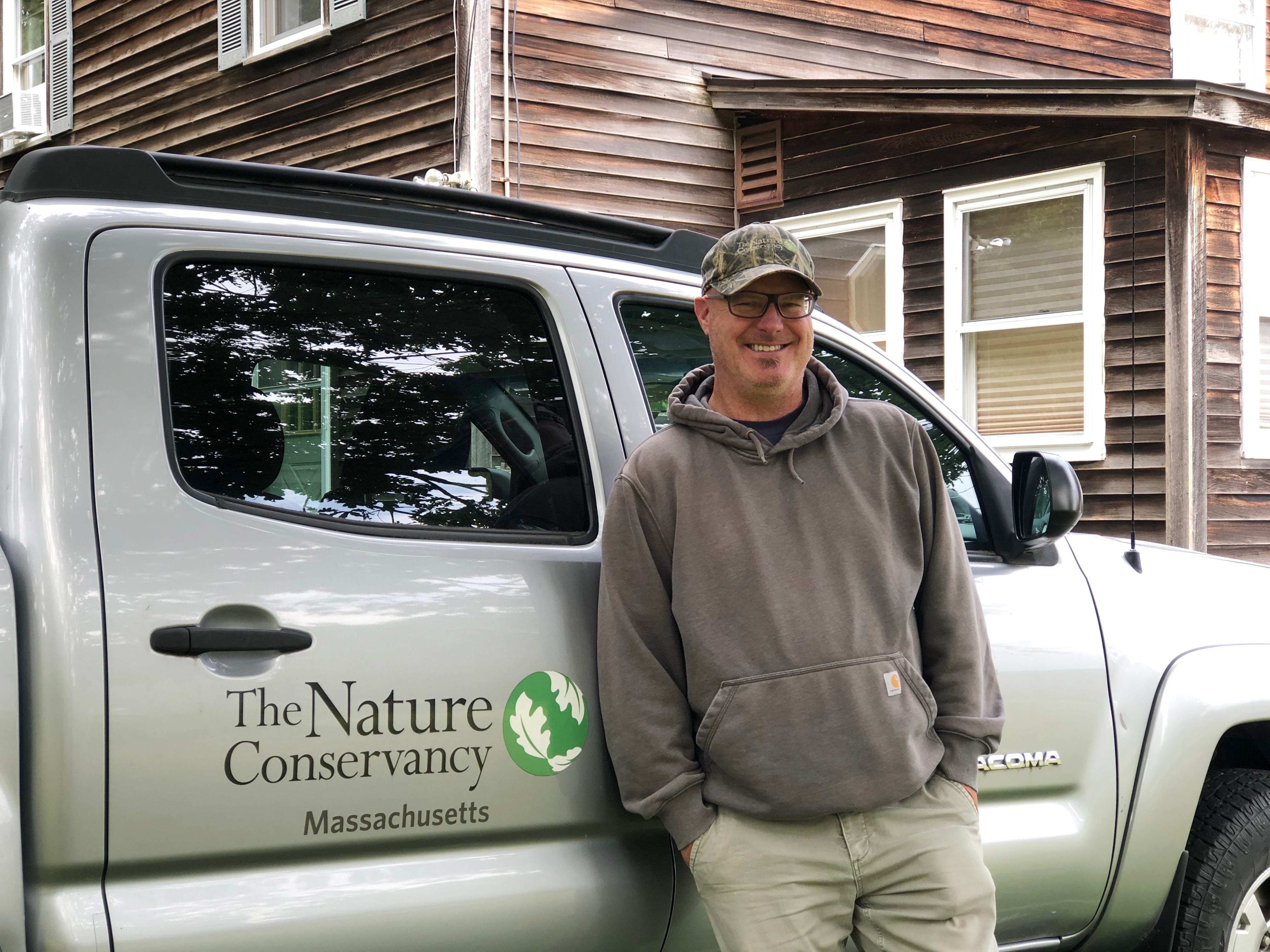
Rene Wendell: Sure. My name is Rene Wendell. I work for the Nature Conservancy out here in Western Massachusetts where I take care of 8,000 acres throughout most of western Mass. Everything from Gill down to Sheffield. Lived here all my life, except for a brief stint away as a young man in my 20s, out in Florida and Arizona. Graduated from BCC, Berkshire Community College, and MCLA, Massachusetts College of Liberal Arts. The son of a trapper, taxidermist, entomologist, hunter, fisherman. Never really had a choice in life, I was always, I guess, destined to be a naturalist. I joined the Hoffmann Bird Club when I was in college at BCC, in the ornithology department. Richard Farren, he taught that. He’s recently released a book on the birds of Rhode Island. He made us join the Hoffmann Bird Club. So I’ve been a member ever since.
MF: You have already stepped down, but you were the president of the bird club until recently.
RW: I was the Pandemic president. I’m the only president of the Hoffmann Bird Club that never attended an in person meeting. All mine were over Zoom. Pretty funny. But yeah, I’ve been doing programmings for the Hoffmann Bird Club since I started there. Leading walks and talks, hikes, looking for owls, stuff like that.
MF: Yeah, I’ve noticed Hoffmann Bird Club brings in speakers from outside the club sometimes and has a lot of lectures and stuff like that, in addition to bird walks.
RW: Yeah, we’re lucky. One of our people on the executive committee, Matt Kelly, does an amazing job of getting really top notch speakers to come speak to the club. Over the pandemic, we extended it. We used to not meet in January and February, but now we have Zoom meetings. I think the Zoom meetings actually increased our membership quite a bit. You know, got our name out there. We’re up over 350 people in the club now.
MF: Oh, wow. Because it really gave people options, many ways to participate in the activities.
RW: Yep. I think we still do them hybrid too. So you could tune in via Zoom, even when we do in-person meetings.
MF: There are not just birders who are going out for a walk, but a lot of people want to learn about birds because they see them in their backyard. Do you think these lectures are serving that part of the population?
RW: Yeah. Matt does an incredible job. I can’t speak to what this guy does for our club. We have topics, everything from, “hey, Joe Schmo went on a birding trip to Costa Rica and he’s going to tell you about his birds.” to top notch scientists from Cornell. We had the guy who is the foremost speaker authority on crows. So he delved into the science of crows like nobody else knows. So everything runs a gambit right from people. If you’re a beginner, there’s something for you. If you want the science behind the latest that’s happening in the bird world, we get that as well. So we’re incredibly lucky that way.
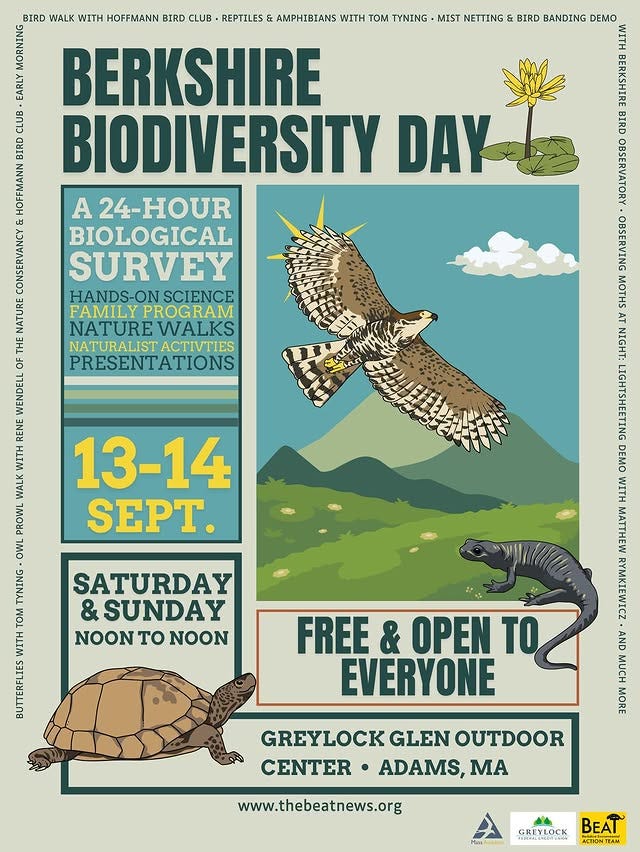
MF: Well, let’s ask you about the Berkshire Biodiversity Day, which just happened on September 13th to 14th, over the weekend.
RW: 24 hours. Yeah.
MF: Would you like to first explain what this event is?
RW: Yeah. They called it a Biodiversity Day. We used to call it a Biodiversity Blitz. This is our 16th year we’ve been doing it, done it all around Berkshire County, different state forests. We did it up on Mount Greylock one year.
It’s 24 hours of seeing as many species as you possibly can. The organizers have been the Berkshire Environmental Action Team. They’ve been a part of this all 16 years. You try to get experts in the field, try to get somebody to do birds, which is usually me or another member of the Hoffmann Bird Club. Somebody puts out a moth light. People that do the plants. Tom Tyning does snakes and frogs. And this year he did butterflies. We’ve had moss experts, experts on lichens come out. It’s just fun.
And what BEAT, the Berkshire Environmental Action Team, has always tried to do is put an educational component to it. So try to bring out classrooms, local school kids come out and can learn and stuff like that. It’s free and any level is welcome. And I think this is the first year where they did all the submissions through iNaturalist.
MF: So it’s not just for people to learn, but you also get records, sightings. It’s sort of a survey at the same time.
RW: Yeah. I mean, who knows what this data is going to do? You know, you collect the data and then 100 years from now, somebody analyzes the data and gets meaningful information. It’s hard to say what can be learned, but 16 years is not an insignificant amount of time. That’s a long time to be gathering data. You know, we usually do it in September. It’d be really interesting if you go back and maybe did it 20 years later on the same date. Are you getting the same species? Has things changed with climate change? Would you get different species if you did it in the springtime? You know, there’s all sorts of things you could do with it. It’s a lot of fun, certainly.
MF: The Hoffmann Bird Club takes the bird-y part of the event. Have you always been involved since the beginning of the BioBlitz?
RW: Yeah, 16 years. Because in preparation for this, I went back and I did some looking. I think I’ve been to maybe three quarters of them doing the owl prowl. I used to run a place called Bartholomew’s Cobble in Sheffield, and when I was there, I did owl prowls. That’s when these Biodiversity Days started. And I’ve been doing the owl prowls ever since. I forget if I was away a couple of times. But most of the time. And the Hoffmann Bird Club’s been participating, I think that we lead a bird walk every year in conjunction with the Biodiversity Day.
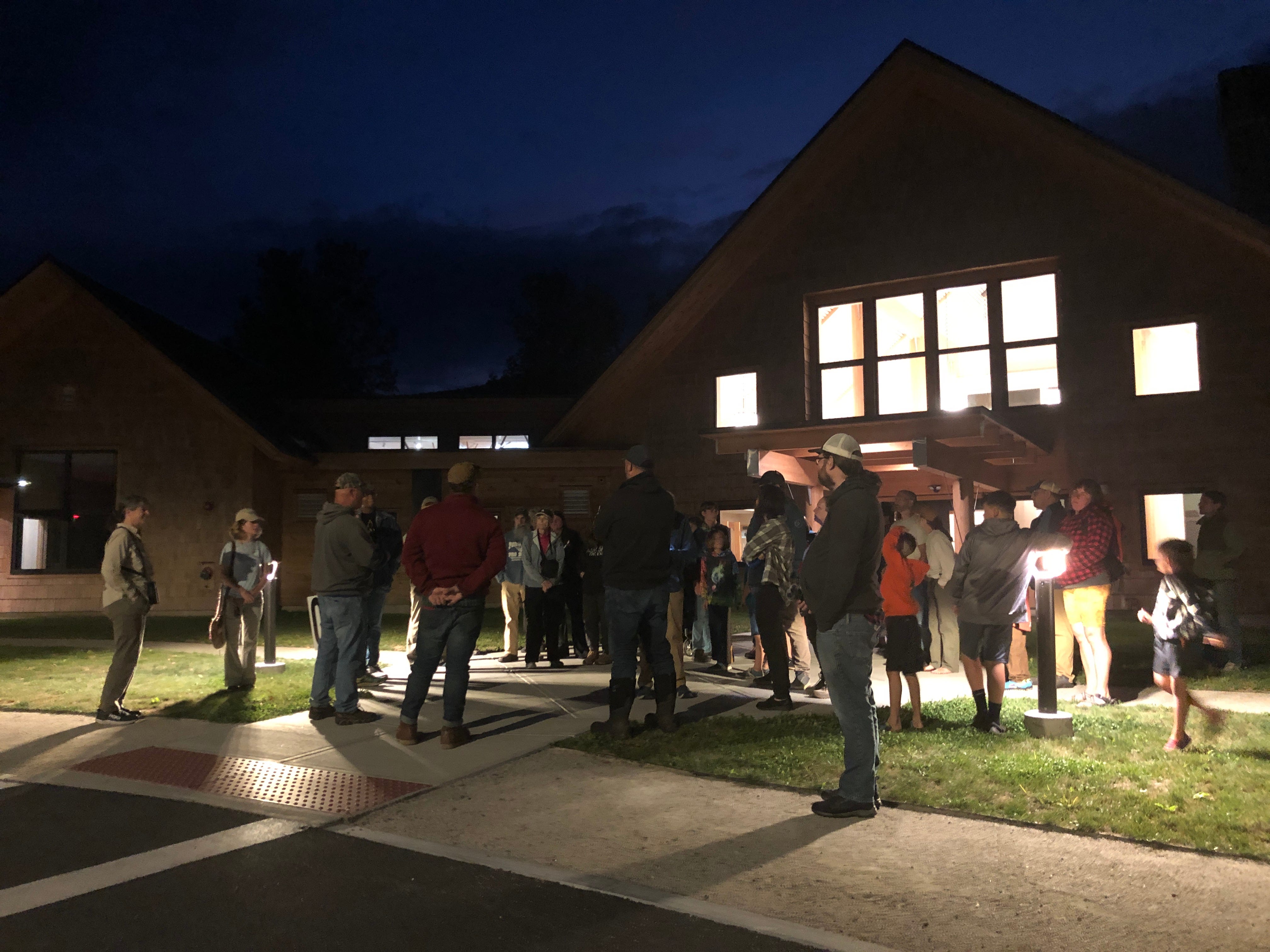
MF: You have the daytime birding activity and then the owl prowl, which I participated in this year. It was quite fun. Kind of a very unusual experience.
RW: Boy, 50 people were there. (laughs)
MF: That was a very big group. I was shocked. Almost too many people.
RW: Well, there were too many people. But you know, it’s supposed to be fun. I think the funnest part was when the coyotes started calling. And we all pretended like we were a pack of coyotes. They didn’t return back. But I have had coyote packs return. You know, once we start calling as a pack, they’ll come a little closer. It’s pretty fun.
MF: And what was your plan if they did show up in front of us? (laughs)
RW: Nothing to be afraid of. We’re 50 strong. It’d have to be a pretty gnarly pack of coyotes to attack 50 people. We could have taken them, I think.
MF: Well, I did a few recordings of this whole walk while I was there, so I have some footage that I can play on the radio, so people would know what we’re talking about. But yeah, it was quite funny because there were a lot of kids. And it’s impossible for kids to be like, not moving around and being quiet. [Especially when] Zach or you or Jonathan started playing recordings or trying to mimic. You guys are pretty good at mimicking those owls.
RW: Thanks.
MF: I mean, I don’t know what owls think. I thought it was convincing, but maybe owls don’t, I don’t know.
RW: But we got one distant one. Way, way out in the distance. And possibly Zach thought he might have heard a Saw-whet (Northern Saw-whet Owl.) But you can imagine if you have far fewer people. If there’s one or two or three of you, you have a lot more success. 50 people is a lot. We sounded like a herd of elephants out there walking around.
MF: Right. There was a kid running around in the dark and he fell into a ditch. Can’t you just, like, can’t you just not fall into a ditch? (laughs) It was so hilarious to be with the kids.
RW: I didn’t know a kid fell into the ditch. That’s funny.
MF: But anyhow. You really helped us learn what to pay attention to. The bird calling back would be an obvious sign, but to hear that the crackling in the trees and something falling, like a little branch maybe, stuff like that could be the sign of them being present.
RW: That was funny though. The branch fell. I had my eyes closed and I had my hands cupped around my ear so I could hear that distant owl. And the branch fell, and I looked at Jonathan and Zach, and they said that they thought there was an owl in that tree. I thought they had seen it fly into the tree. So that’s why we spent like half an hour calling to that tree. Turns out, we were just calling to an empty tree. (laughs)
MF: Well, you don’t know. We don’t know. (laughs)
RW: Well, I don’t know. I’m like, what do you mean you didn’t see the owl fly in there. What are we doing here? We’re just calling to this tree. So I thought that was pretty funny.
MF: It is pretty funny. I mean, we have to try, and we can only try.
RW: Yeah. What else are you gonna do on a Saturday night? Spend it with 50 people hootin at owls? It’s a lot of fun.
MF: Yeah. And then there was somebody who was calling back. Who was that?
RW: Oh, that was the moth guy. The moth guy at the light. So I’ve got to know that guy. I see him every year.
MF: Matthew something. I see his name on eBird all the time.
RW: He got me too. I was like “oh, here.” And then he called again. I could tell it was a person. Which isn’t funny, you know, like I’m trying to run a professional show. You don’t see me making moth calls, do you?
MF: Right, right. (laughs) So I know how the owl prowl part went this year, but you also led the daytime bird walk. Were there any memorable moments, sightings? You said the official record is not out yet.
RW: Yeah. So the tally from all the different species we got, I went through and I did a preliminary check of the birds we’ve seen. So I think we have 56 bird species so far.
MF: 56, wow.
RW: There’s a hundred people there throughout the day. They’re submitting their own lists. So we’ll see. But at least 56. Warblers were pretty strong. You know, September is great for warbler migration. Wilson’s Warbler, Northern Parulas. Ben Nickley caught a Northern Waterthrush in his mist net, which was pretty great. Nashville Warbler, Tennessee Warblers. Yeah, the warblers were pretty strong. I think we had Lincoln’s Sparrow, somebody said that they had it. I didn’t see it, it was before I got there in the evening. Somebody had an Evening Grosbeak, which is pretty unusual, but I didn’t get to see that bird. But yeah. Some crazy plants: it was with Zach Adams, we were walking the brook, and we got Brook Trout in the stream, and Zach found a state-listed plant, a rare plant. So I think that might be the highlight for me, finding that plant with Zach. Can’t tell you what plant it is because it’s a state-listed species, but it’s a species of special concern in Massachusetts. Pretty rare.


MF: That’s pretty cool. Warbler-wise, compared to, say last year, is it a significantly bigger number this year?
RW: No, last year was held at Berkshire Community College and we got a nice warbler fallout there too. If the weather’s right in the springtime and it’s nice and clear, sometimes even a little rain over the night will help. But if you’ve got good movement, then, a place like Greylock Glen is going to get a lot of warblers. BCC is the same thing, it’s up against West Mountain. Those birds are traveling north and south along the mountain range. The same thing with Greylock Glen. They’re traveling in the valley below the mountain range. So I think we had a similar number of warblers.
MF: So you were there pretty much the whole day?
RW: Yeah, I do it all 24 hours. I go home to sleep, but I go to everybody’s stuff. It’s such a rare opportunity to meet and mingle and mix with experts in their field. When do you get to hang out with somebody that knows everything about moths? Do you know what I mean? Were you there for the woman that does the algae? She found an incredibly rich diversity of algae, algal species in that little pond and she had them underneath her microscope and she was showing everybody all the different algal species. When do you get to hang out with somebody that knows everything about algae? I always think of it as an amazing opportunity to learn and to be amongst fellow geeks. That kind of makes me happy. When you do a Biodiversity Day and you look at the whole of the ecosystem, you’re looking at the whole area. You’re there, you’re observing everything. You’re looking at beetles, you’re looking at crane flies. You know, I found a cicada. I don’t know if anyone else found the cicada. You get an appreciation for the whole, the entirety of the ecosystem, I think. But you’re asking me, was there any special thing that really stuck in my mind? I went to Tom Tyning’s Butterfly Walk. And I said, hey, Tom, I got a Viceroy. Do you know what a Viceroy is?
MF: No.
RW: You know what a Monarch is, right? A Viceroy looks just like a Monarch with the orange and the black, but it has two stripes in its lower wings to differentiate it. It’s a different species. And Tom’s like, stay with that butterfly, Rene. And he goes, look at it, stopping individual plants in the field and then leaving. That butterfly is not nectaring, it’s laying eggs. He goes, watch it. So I watched it land and it landed on this little willow bush and it laid an egg. And he goes, did you see that land? I said, yes, I’m looking at it. So I kept my eye on it. And then he came over with everybody and I showed him where it laid the egg. And I found a little tiny egg at the tip of this willow leaf. And I asked if anybody had a macro camera to take a photo of it. Somebody had an amazing macro camera. I hope it gets up on the website. I hope it does. But an amazing photo of this Viceroy egg underneath a macro lens. It’s amazing.
MF: So they lay one egg at a time.
RW: One egg on one leaf. If Tom didn’t tell me to pay attention, I would have just said “Viceroy, well, check”, you know, I wouldn’t have watched it. So if you think about that, a caterpillar has to hatch out, eat as many willow leaves as it takes to get it to become fat enough, then it has to pupate. I gotta look into it. Willow leaves are going to lose their leaves soon. So that egg has to turn into a caterpillar and eat its fill. And then Tom says they drop into the leaf litter. I don’t know if they pupate within the leaf litter, you know, form a chrysalis. Because they wouldn’t do it on the leaf. And then the leaf drops. They must go into the leaf litter and then pupate and then come out as a new butterfly in the spring. Crazy.
MF: This is something I find interesting over and over again, that once you’re equipped with the knowledge, then you actually get to see it. Until you know that such a thing exists, you can easily overlook it. That was my experience with birding too. I started birding in New York City, and there’s a lot of birds there. You get to see this biodiversity even in a very busy urban setting. But because I was not equipped to see them, I just didn’t see them at all. So I think events like the BioBlitz open to the public are great. And also the bird walks and events that Hoffmann Bird Club hosts would help people who are not equipped with those skills learn how to see things, and they can appreciate what’s around them more than they are right now. So that your life is more fun, basically.
RW: Yeah. And it usually takes a spark, right? You see one bird and you want to see another bird, and pretty soon you’re like, man, there’s so many birds. And I want to know more about birds. That’s why when we’re talking about kids and howling at coyotes and falling in ditches, you know, kids need to be introduced to this stuff. They need to fall in love with it. Because if we don’t fall in love with nature, then we don’t protect it. You don’t protect what you don’t love. You don’t protect what you don’t know. So the more people that come to these events, I don’t care if there’s 50 people on my owl prowl. You know, we might not get as many owls, but I hope everybody had a good time. Fall in love with it, get curious about nature. And the next generation of stewards comes and they protect places like Greylock Glen where this event was held.
You know, that’s what I like about birding. You do it at any skill level. You don’t have to be incredibly proficient at it. You don’t have to be an expert birder. You can just go outside and watch the robin that’s in your backyard. You can get a cheap pair of binoculars and try to find a Common Yellow-throat that’s in the bushes. You don’t have to be the best. And, you know, that’s what I tell people about nature. Just enjoy what’s there. You don’t need to know the name of it to find it interesting. I don’t know the name of most caterpillars I see, but every time I see a caterpillar, I’m like, “look at this thing. This thing’s amazing!”, right? You don’t need to know the name of it.
MF: To attend the owl prowl and see what you and Zach and Jonathan would do, too, gives you an idea that, okay, you can play – I mean, would you recommend people play recordings? You have to know how…
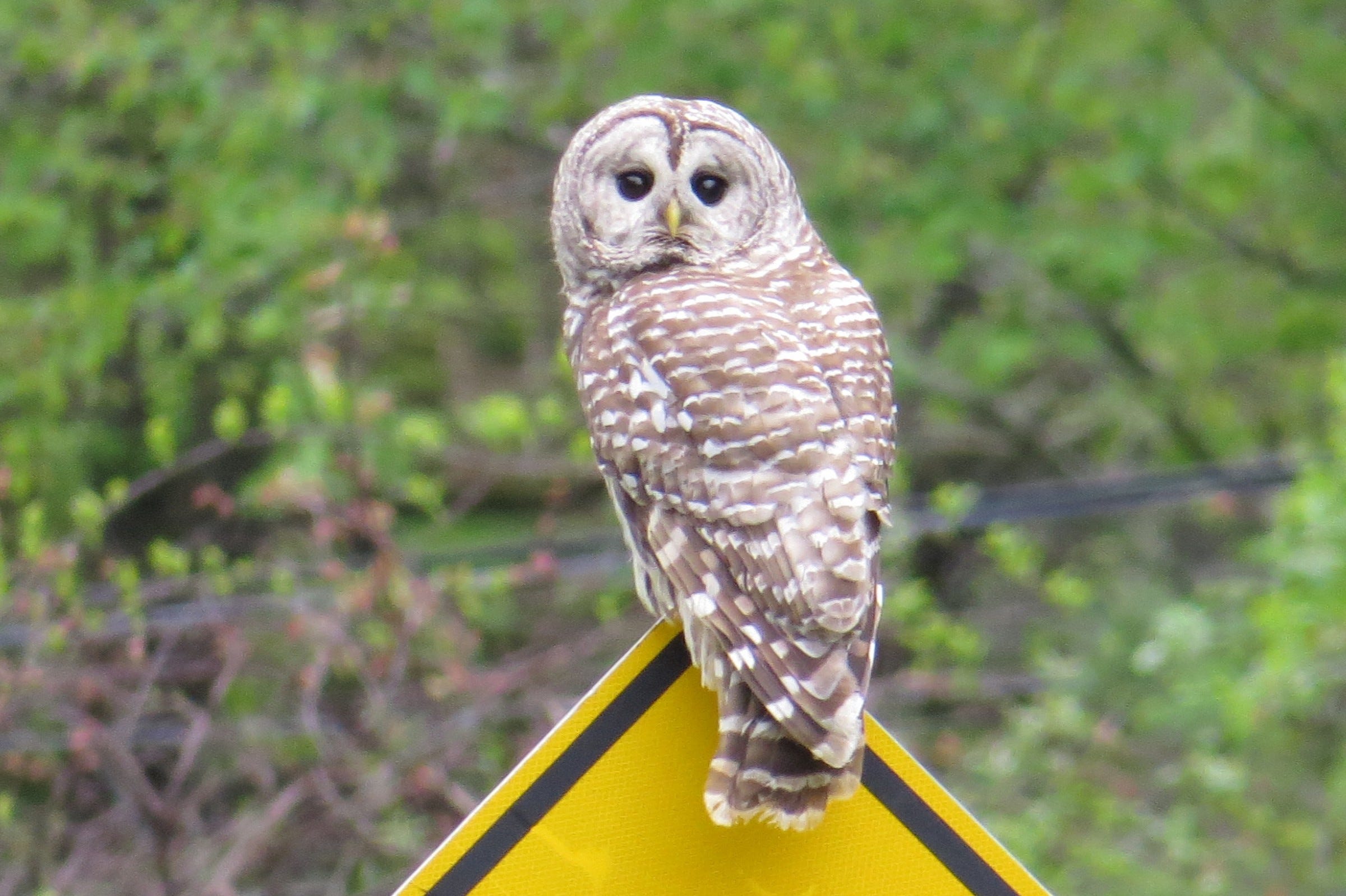
RW: Yeah. Playback. That’s a hot topic. You don’t want to play playback during the breeding season, for instance. You don’t want to screw birds up. This time of year, the owls have already had their babies. The younger juveniles, sometimes they’re suckers for calls, like the Barred Owl. You know, playback’s tough. You gotta be careful with it.
MF: Right. You need to understand the science behind it, the do’s and don’ts. But I can easily see you inspiring kids to learn how to mimic owl calls because it’s kind of funny and a fun thing to do. And that’s the kind of thing, if you don’t see people like you doing it, you don’t necessarily know that such activity exists in the first place, and that it could contribute to science. So I thank you all for doing this kind of activity. And so I would like you to talk a little bit more about the Hoffmann Bird Club and how people can participate.
RW: Sure. Hoffmann Bird Club started in the 1940s by Bartlett Hendricks. He was the curator of the Berkshire Museum. He started a club and it was named after Ralph Hoffmann, a naturalist from the Berkshires and he wrote arguably the first bird field guide. And after that, you know, Peterson and others started to refine it and make it better. So it’s named after Ralph Hoffmann. Like I said, we have 350 members. We do all sorts of walks and talks, lectures, which can be viewed via zoom. We have a website, hoffmannbirdclub.org. Any skill levels invited. We do all sorts of social events where we have picnics and potlucks and, yeah, just crazy bunch of people who like birds.
MF: So people can check out your website and register for walks or show up.
RW: Indeed. I would give you one date if you want to participate, for any listeners out there. November 8th is our next big event and it’s the Berkshire Natural History Conference. That’s being held at Williams College. I am the master of ceremonies for that event. We get speakers and some of the most knowledgeable people in their field to talk about different aspects of nature that could be seen in the Berkshires. I don’t have a list of the speakers yet, but they’ve always been phenomenal. You can look that up online, Berkshire Natural History Conference. I don’t think tickets are on sale yet, but it’s November 8th.
MF: Great. Thank you so much.
RW: No worries. Thanks for having me.
Field Recordings from the Owl Prowl 2025
I joined the owl prowl this year and recorded some of the impressive owl imitations by the Hoffmann Bird Club members! The coyote callings included.
Bird-inspired Music of the Month
Inspired by the Hoffmann Bird Club members’ impressive imitation of owls during the owl prowl, this month’s broadcast featured recordings of Inuit women imitating geese, Tuva people imitating owls and wolves, and the Kayabí, an indigenous group from Mato Grosso, Brazil, imitating birds.
Related Beakuency article
Owl-Banding by Berkshire Bird Observatory

Buddhists say you can be happy without hope. Small creatures remind me of that idea. Even a small chickadee, a tiny woolly bear, a teeny caddisfly larva is a determined pure force living fully in the present, no matter what the odds are. My birding friend Mike Birmingham told me that monarch butterflies migrate in several generations, with each generation traveling farther north than the last, so the one who started the journey doesn't even see their destination. All these little beings, they just keep going, probably without thinking about whether there is any hope of success. If there is no concept of hope, there is no giving up.


