

For Integration, Against Demonization
On Indigenous frameworks for invasive alien species management, learning others' language, and immigration.

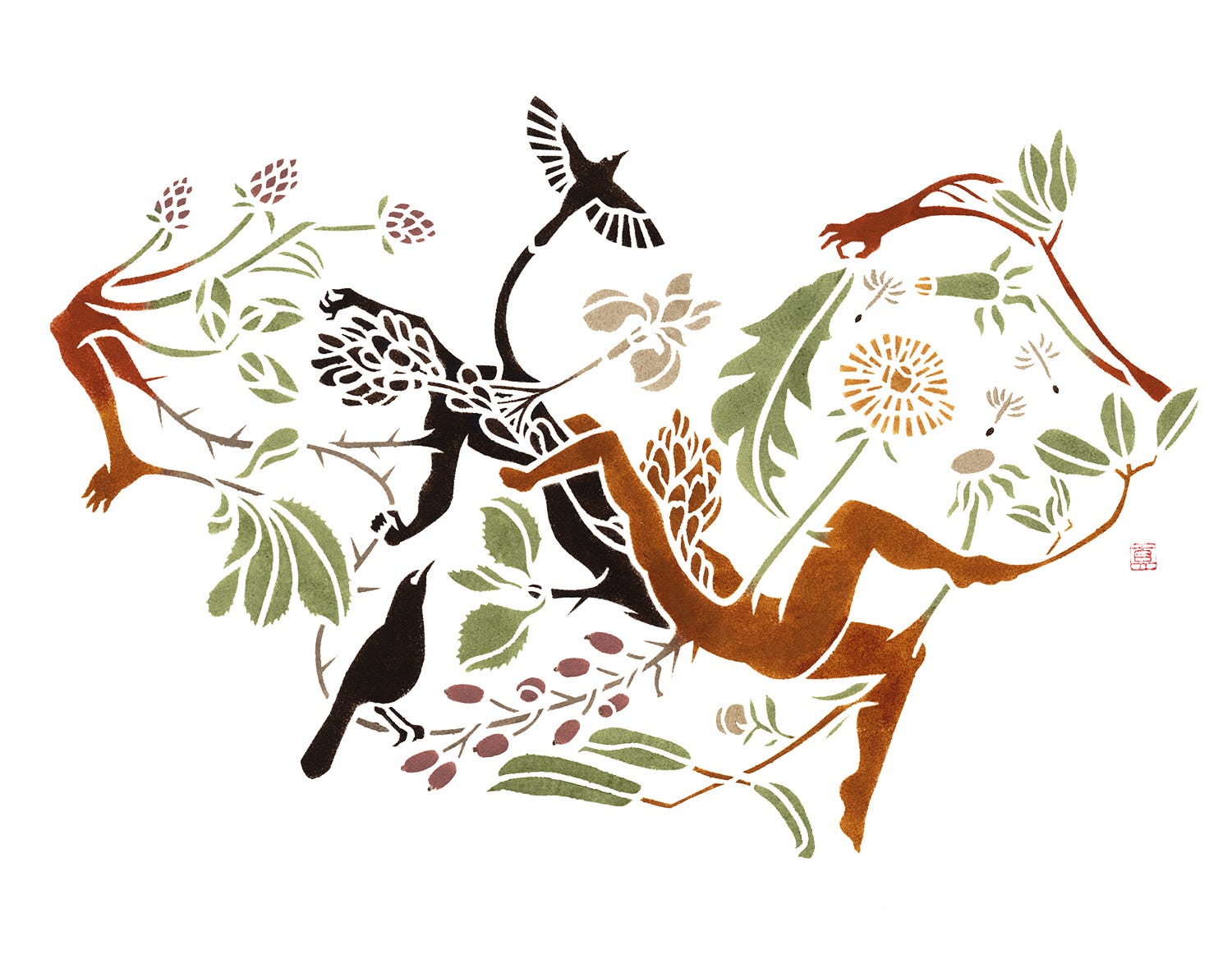
The real challenge of learning a language that is not your own is understanding the emotional impact a word or expression carries for native speakers. This is obviously far more complex than reading dictionary definitions. I remember, 15 years ago when I started taking ESL classes, feeling surprised to learn that the word “primitive” did not have a straightforwardly positive connotation in American English, and that I had to be careful using it. To me, primitiveness suggested a source of energy residing in the core of our being.
The same challenge arises when I talk about invasive plants. When I use words like “reflection” and “responsibility,” I only know what they mean to me. I don’t really know how they sound to you.
And that is the long way to integration: bringing different perspectives, different people and species, into how you communicate, into your world, your ecosystem.
I could not have integrated without the help of the people around me. I have been fortunate to have friends who were patient with me and treated me as a real person when my English was pretty much zero. This is what makes me wonder: if I could integrate with enough help, could invasive plants do the same, instead of simply seeing them as invaders who need to be fought off?
Not only my experience of immigration, but the culture I was raised in has had an influence on this perspective. Despite our modernized, Westernized lifestyle, Japanese kids are still familiar with folktales that frequently follow this structure:
Human transgression against nature (cutting sacred trees, polluting water, disrespecting spirits)
Natural retaliation (floods, storms, curses, disasters)
Ritual appeasement (prayers, offerings, replanting, building shrines)
Restoration of balance when rituals succeed
Beyond folklore, many works of pop culture repeat this ancient theme. Probably the most internationally recognized example is the 1997 Studio Ghibli film Princess Mononoke, directed by Hayao Miyazaki. At the beginning of the film, a demon (once a wild boar, transformed by habitat loss) attacks Prince Ashitaka’s village. He confronts it to protect his people, showing his respect for life and his desire to understand and appease the creature rather than immediately destroy it.
“Calm your fury, o mighty lord! Whatever you may be, god or demon, please leave us in peace!”
The wise old woman of the village then kneels before the slain demon, promising it a proper burial and asking it to leave without bitterness. But the burial alone is not enough. It takes Prince Ashitaka traveling far from his home to find the root cause of the curse and seek reconciliation.
Western science often critiques such worldviews on ecology for anthropomorphizing non-human things. I don’t think the Eastern worldview is “superior” or “better” either. It is not one or the other. I believe in additions, not replacement: adding a different perspective, a different take, rather than limiting ourselves to one view.
I’ve experienced the value of holding two approaches. When I was young, I had a severe acne problem, along with other health issues that medical tests couldn’t explain. Antibiotics and steroids cleared the acne quickly. I was happy about it at first, but debilitating side effects meant I couldn’t continue. Later I started seeing a Chinese medicine doctor. She would see me once a week and ask: how are you feeling? What did you eat this week? What did your stools look like? And then, based on my answers, she’d mix the medicine for the week. That’s when I realized how little attention I had been paying to my own body. She never told me to avoid ‘bad food,’ but would explain: because this is the tendency of your body, you want to cut this back. Not because it is ‘bad’, but for the sake of balance. I would later find this idea showing up in regenerative farming and indigenous views. This approach took years, but it eventually resolved the acne.
The habit of regular self-reflection laid the groundwork for me to later start psychotherapy to address the real root cause of my physical symptoms, encouraged by the solution-oriented Western mindset I was exposed to while living in NYC. These two approaches are not mutually exclusive; they supplement each other.
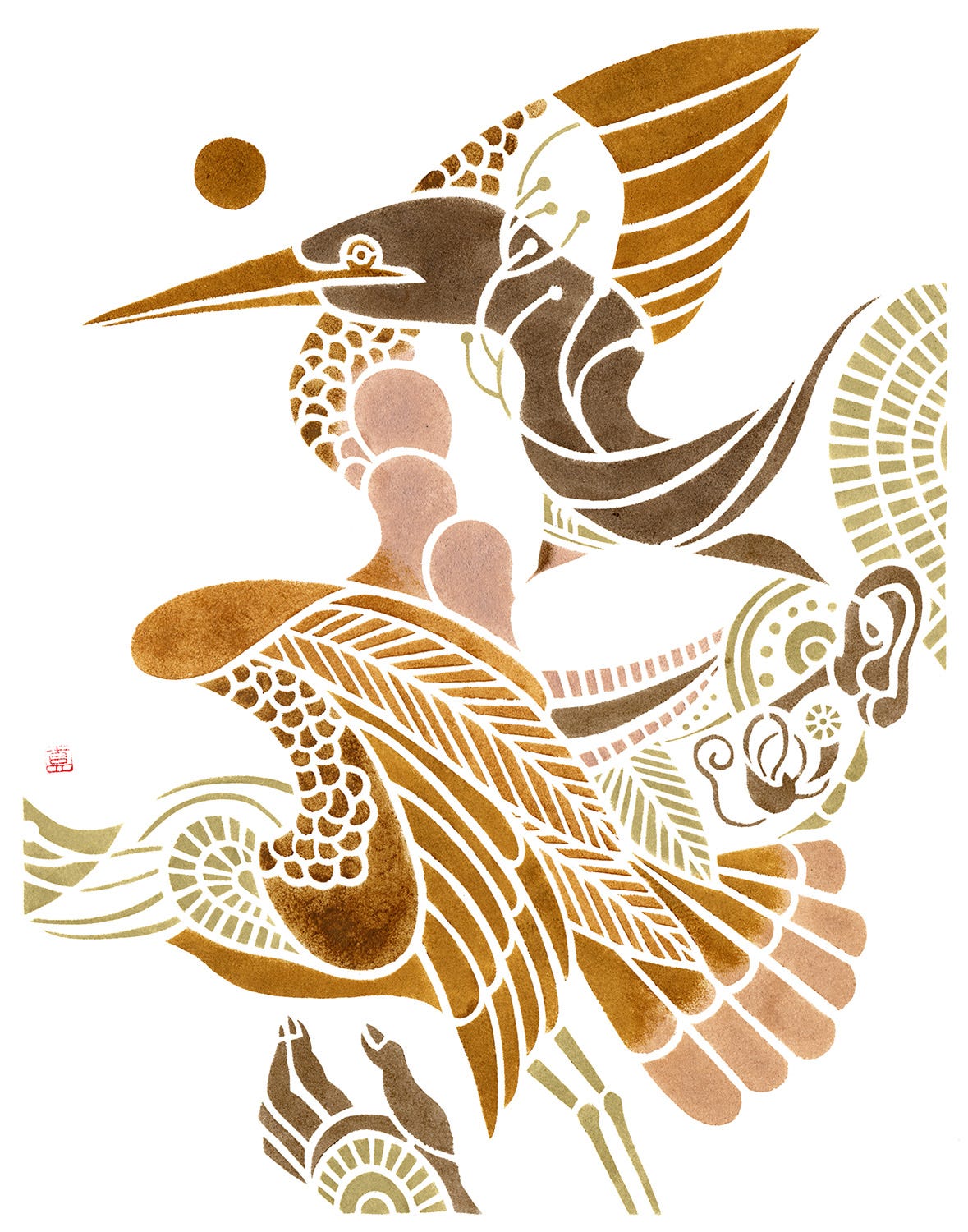
Invasive species management is often urgent, and in Western conservation science, the language of elimination is considered responsible stewardship, not aggression. To Westerners, my inherited views on ecology may read as charming but illogical. But why does Western conservation science apply the logic of eradication to plants and animals but not to human settler populations? Is the Western logical mind for integration, or for eradication?
And here lies the challenge of integration. I will always be in favor of integration and I want to find a language that bridges differences, because confrontation would lead us nowhere. We have to be in this together. But I don’t want to silence myself out of fear of offending people who never question their own position as ‘natives’ or their authority to decide who or what belongs. Sometimes those decisions are necessary. But they deserve to be questioned. I resist the normalization of the language of eradication and demonization when it comes to ‘others,’ human or non-human. As someone who chose to live in a new world where I am the “other,” I feel I have no choice in this matter.
I’ve been working over 15 years to learn your language and bridge our gap so I can understand you. I've been spending hundreds of hours on this Beakuency project that is purely a labor of love: researching, interviewing, and listening to local conservationists whose work I admire and whose perspective is rooted in Western science. Will you try to understand me?
A 2023 paper, Contribution of Indigenous Peoples’ understandings and relational frameworks to invasive alien species management, published in People and Nature by Wehi et al. was a very powerful read. It made me feel not alone in questioning things and doubting my identity and heritage.
Indigenous approaches to managing IAS perhaps differ from some leading approaches because instead of setting up conceptual divisions, such as introduced, alien, nonlocal and native, Indigenous approaches focus on a finer texture of relationships among all species, including humans, in a location and region. We see this as one possible reason why Indigenous management may not necessarily favour eradication as a fundamental approach to alien (human-introduced) species that are becoming invasive.
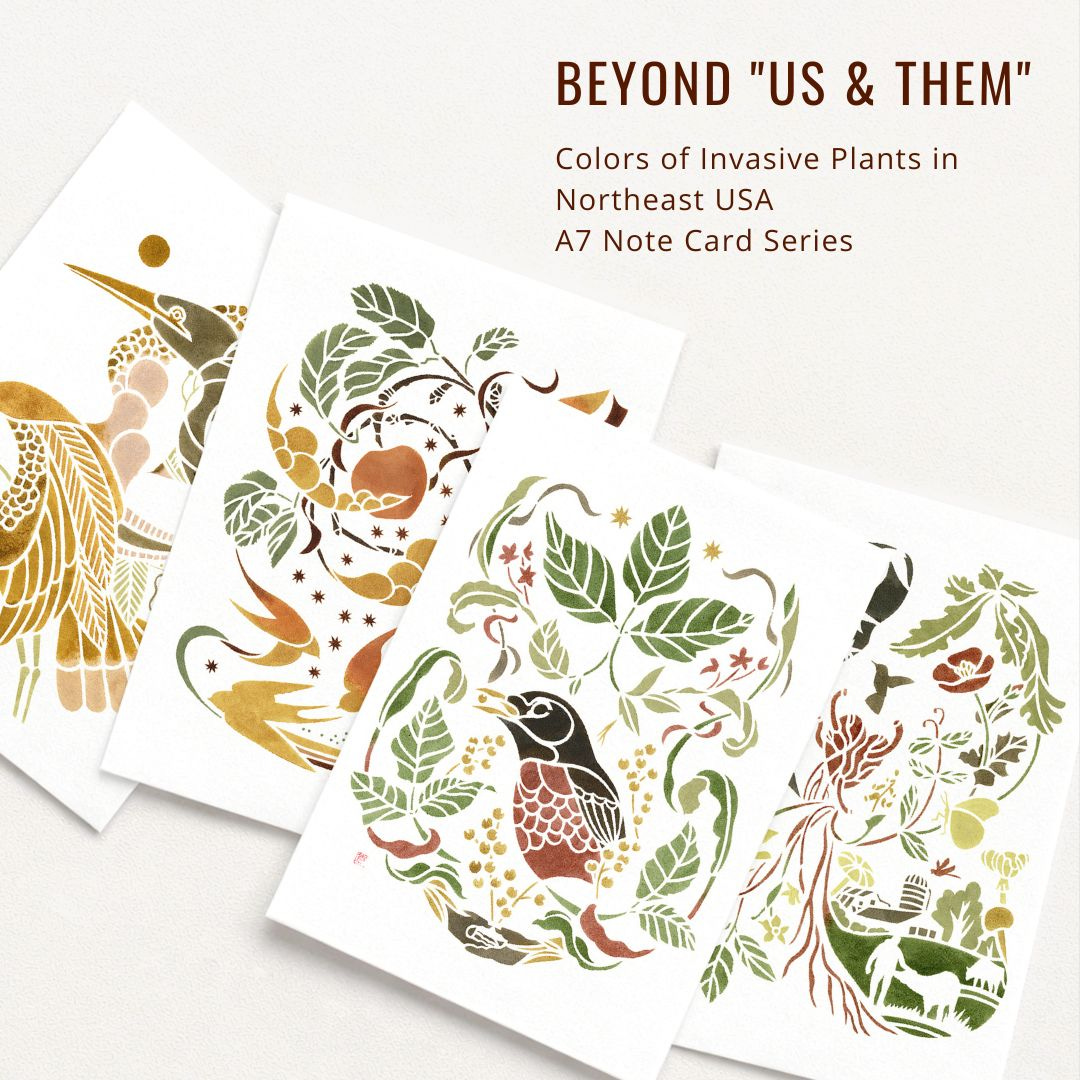
There is no shortcut in building a common language, and I must keep doing my part. In the meantime, for me, it is probably best to let the materials speak for themselves, to let the plants speak for themselves through art.
Wehi, P.M., Kamelamela, K.L., Whyte, K., Watene, K., and Reo, N. (2023). Contribution of Indigenous Peoples’ understandings and relational frameworks to invasive alien species management. People and Nature, British Ecological Society.
Related Article
Interview with Kevin Clark and Dallas Houston (Rose Hill Farm): To Live and Farm as Part of the Whole World

Beakuency welcomes Kevin Clark and Dallas Houston of Rose Hill Farm, a family-owned pick-your-own apple orchard in Red Hook, NY. Rose Hill Farm takes the entirety of the property and its surrounding community into account when making decisions, and approaches the orchard as a complex ecosystem where every element is interconnected. To them, birds are indicators of ecological health that provide “eyes out in the orchard.”
When you don’t feel alone, and you feel like you have a community you can depend on, when things go wrong, you can get help. [Then] People will be, I think, operating in a little bit less from a place of viewing all these things as destructive, taking money, taking time, and [instead] viewing themselves as just a part of this. Human beings are not this exception, we are a part of this world. And as much as farming is human creation, it takes place amongst all these pests and disease or insects and all these things that exist, invasive things, and you have to work with that. And I think it’s actually a lot harder to work with it when you view them as your enemies, even though it can feel like that’s the only way to view them sometimes. I think, letting go and letting yourself become part of this larger picture, even though it requires some relinquishing of that feeling of wanting to control everything and is really scary. (Interview excerpts)
Upcoming Event
Cornell Cooperative Extension Columbia and Greene Counties’ Spring Gardening Day 2026
Saturday, March 28 2026
8AM-3:30pm
Location: Hudson Junior High School (215 Harry Howard Ave, Hudson, NY 12534)
Spring Gardening Day is back! Join us for a full day of learning, inspiration, and connection for gardeners of all levels. This in-person event features practical, science-based workshops, a keynote presentation, vendors, and plenty of opportunities to learn from—and connect with—fellow gardeners.
Fee: $45. For more information and to register, please visit here. I will have a table with Birds of Hudson Valley note cards and some invasive plant pigment art. Hope you can join us!
I appreciate this angle on the invasive/non-native (etc) argument. Especially in regard to a different form of ecological management as not only a cognitive perspective but also a literal practice. Would love to hear more about how you’re imagining cultivate these relationships! Also, your paintings are so beautiful and pair very nicely with this essay.
Have thought about the invasive-species/human-colonizer parallels a lot recently, especially with yellow crazy ants, this is really nice material for reflection! I've wondered if treating humans and nonhumans on more equitable grounds would invest invasive species (especially those as aggressive, organized, and exploitative as yellow crazy ants) with meaningful responsibility for their roles in ecological destruction, and where the implications of that could(/should) end up.