

Creating Artwork Guided by Farmers: Collaboration with Hawthorne Valley Farm
A new art project for Hawthorne Valley Farm's Biodiversity Trail using invasive plants, inspired by the farm's living ecosystem, and 100-year-old poems.

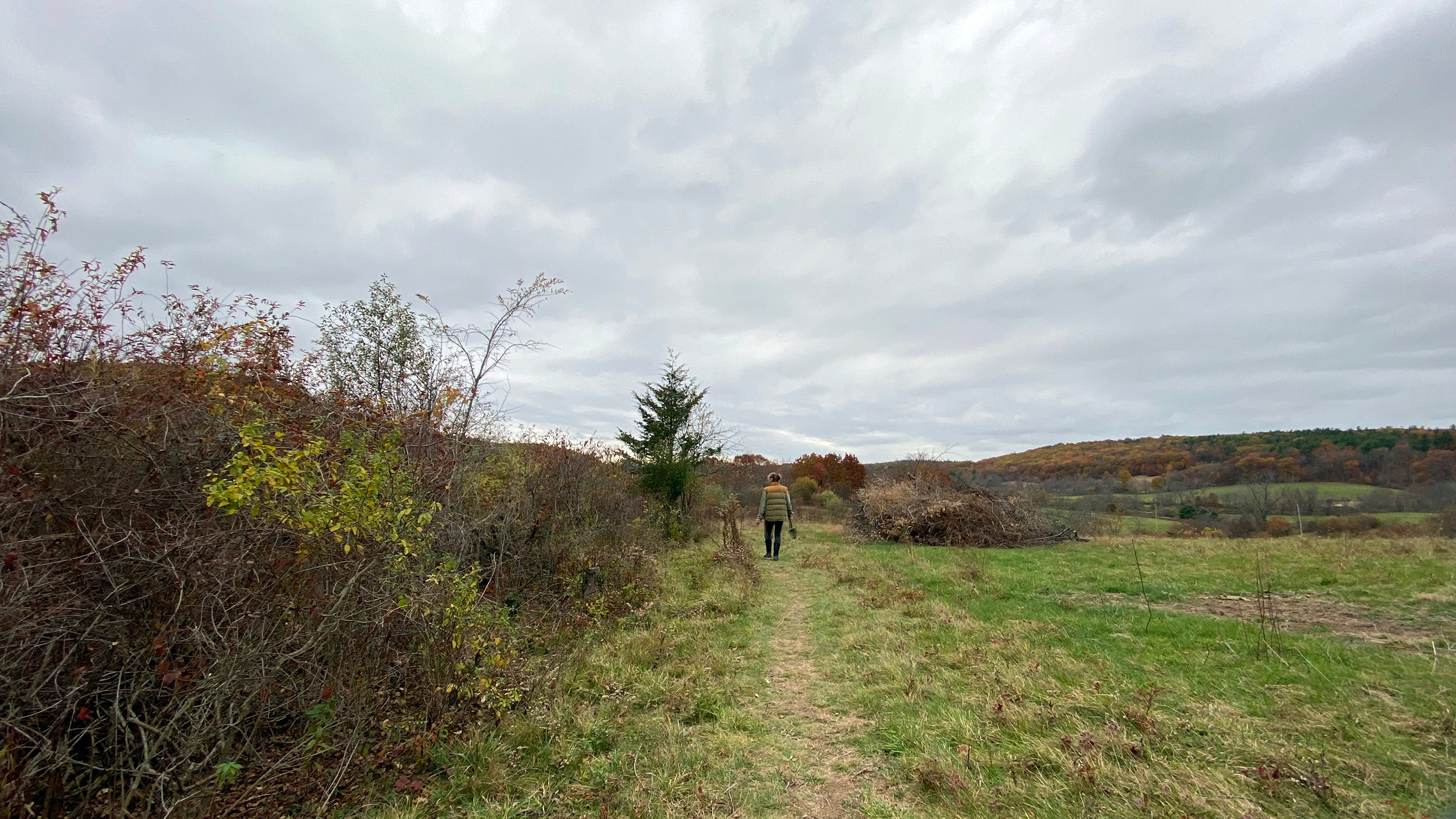
Biodiversity Trail
A new project has started. I don’t know the name of it yet. But it is for the Biodiversity Trail that newly opened at the Hawthorne Valley farm in Ghent, Columbia County.
A 2022 biodiversity survey conducted by the Farmscape Ecology Program documented nearly 600 species of wild-growing plants, about 100 species of birds, close to 100 butterfly species, more than 250 moth species, and many other creatures—all living within an active farming landscape. From wet meadows to forest edges, these species are woven into the daily life of the farm.
The trail highlights this interconnection. Interpretive signs invite visitors to consider not only the beauty of these species but also how farm practices influence them and how, in turn, biodiversity enriches the land. In this way, the Biodiversity Trail serves as both a celebration of Hawthorne Valley’s natural heritage and an invitation to imagine how farms everywhere can become places where agriculture and wild nature flourish together.
This art installation that I will be working on for many moons to come is a new development from my experiment with non-native plant pigments. It will be a sort of soft mural, stencil painted on fabric. As for paints, I will work with non-native plants that are clearly invasive, dominating many of the resources in the local ecosystem. The paints are made from materials gathered each year, so the colors of the mural will reflect those variations and change over time. This piece is not meant to last forever. It is meant to be tended and redone periodically. No farmer plants things, and then walks away and forgets about them. Since it will be in the farm field, it makes sense to me to try to follow the way of farmers.
Inspiration for this project
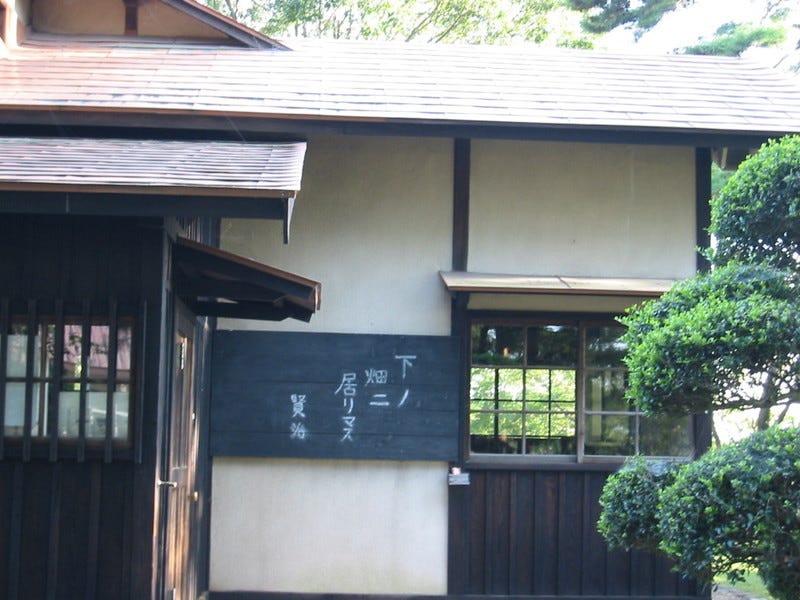
When Spencer Fenniman, the farm manager, asked me earlier this year if I’d be interested in creating art for the Biodiversity Trail, an image came to my mind and has stayed with me since: a chalkboard with the words, “I am in the lower field. Kenji.”
“Kenji” refers to Kenji Miyazawa, a Japanese poet, children’s book author, and a specialist in agricultural science who was born in 1896. I have loved his books since I was ten years old. He taught at Hanamaki Agricultural School before founding Rasuchijin Kyokai, a private school for local farmers. There, he gave lectures on chemistry, soil science, fertilizers, and peasant art theory: a belief that art should grow out of the everyday lives of ordinary people, especially farmers. A fan of classical music, he hosted record-listening gatherings for the local farming community, as well as storytelling events for children. He was a devout Buddhist, and his closest friend was a Christian. His stories often take place in Ihatov, an imaginary world where nature, the universe, and human spirituality are deeply intertwined. He also studied Esperanto, dreaming that one day he could write in a language that would connect him with readers beyond his homeland. He died in 1933.
The chalkboard was at the entrance of the Rasuchijin Kyokai building. Kenji used it to let visitors and students know when he was out working in the fields.
After his passing, the building was relocated and restored on the grounds of Hanamaki Agricultural High School. During the restoration, Kenji’s brother rewrote the same message on the chalkboard, carefully tracing Kenji’s handwriting. To this day, students at the agricultural high school continue to overwrite the message in chalk.
When humans want something to last forever, we often try to preserve it using materials that are strong, durable, and archival. The invention of plastic bags is a good example. They were originally created to save trees, since their durability meant people could reuse them instead of constantly replacing paper bags. In the end, however, the more sustainable approach proved to be maintaining natural cycles by continuing to plant trees and manage forests responsibly. Yet many artworks are still made with this same linear view of longevity, to be archived in museums, kept in collections, or valued as investments.
In the natural world, however, longevity seems to mean disappearing and returning, like a flower that fades in winter and blooms again in spring. It’s less about permanence and individuality, and more about renewal and the collective.
Kenji’s writing remains on the chalkboard to this day, even though it was made with materials that easily fade. Because there is still someone who resonates with him, someone who returns to the board and restores his words, like a new generation of Dark-eyed Juncos returning to the Hudson Valley in winter, showing us their new, yet old, familiar faces.
So that is what my Biodiversity Trail art installation is modeled after. I’ll keep coming back and putting it back like Kenji did. And if it means something to someone, maybe someday they will take over after me. They could use my stencil, or they could create their own. And when there are no longer people who carry this idea with them, that will be the end of this art installation.
First Foraging
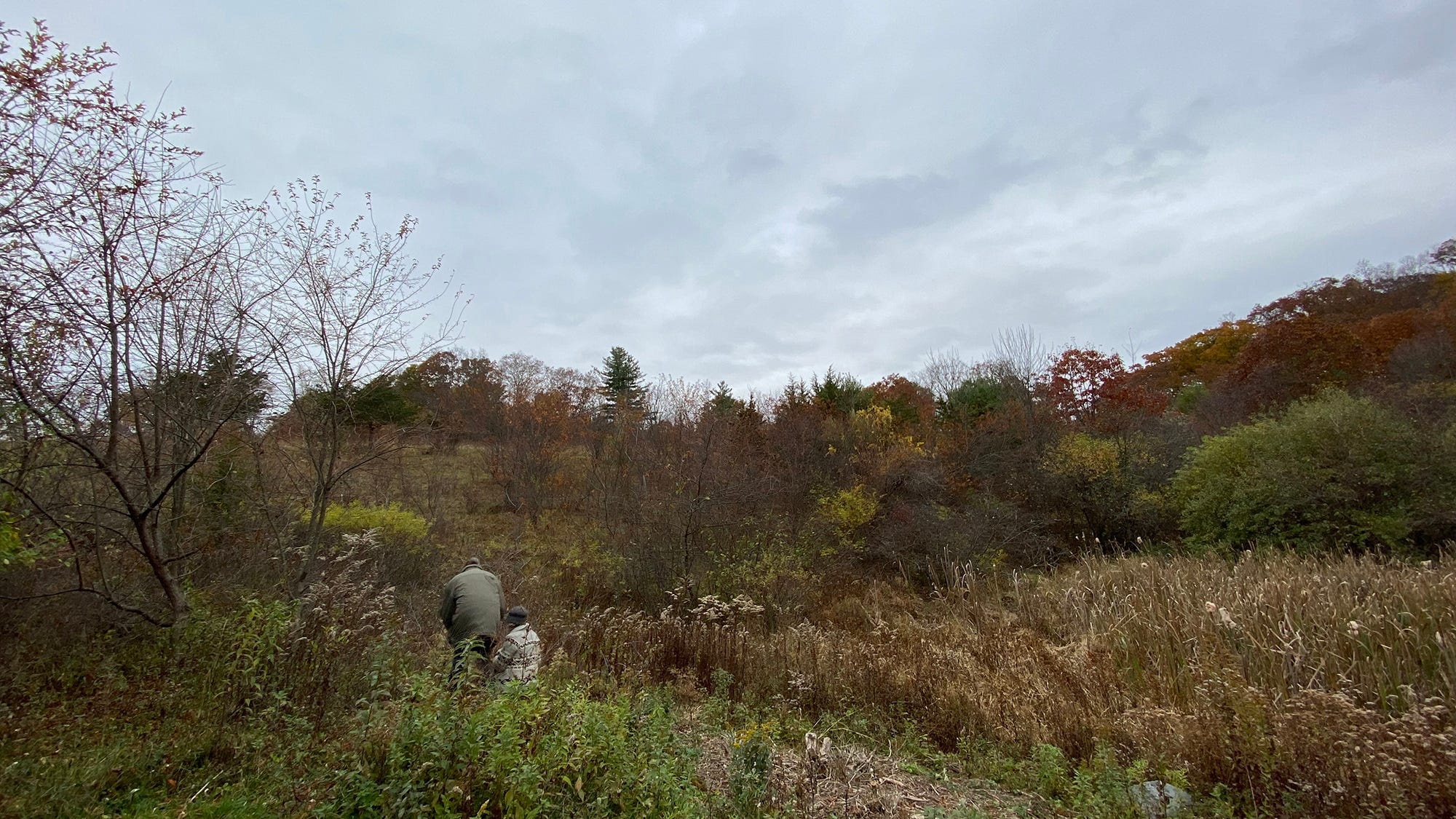
October 29, I spent a couple of hours foraging for invasive plants along the trail. Claudia Knab-Vispo and Anna Duhon from the Farmscape Ecology Program helped me with accurate plant identification, suggestions, digging and picking. I already learned so much in this one trip.
On the way to Hawthorne Valley Farm, there was a brief shower, but when I arrived, the sun peeked out. Anna said we might see a rainbow. A little later, the sky was covered in clouds again.
帰りみち、ひでり雨が降りまたかゞやかに霽(は)れる。そのかゞやく雲の原
今日こそ飛んであの雲を踏め。
On the way home, a sudden shower falls
and clears again in a flash. That fleeting expanse of bright clouds,
today at last I’ll fly and tread upon those clouds.
(Kenji Miyazawa, “秋田街道”)
We collected berries, roots, and barks of 10 invasive species. The next step is to experiment and find out what colors they produce. I hope to find good uses for these plants, many of which I share a homeland with.


